
PLOTPROFOUND ◆ TOLKIEN ATLAS ◆ KNOWLEDGE PILLS
Why Can’t the One Ring Simply Be Hidden Forever?
The problem is not only discovery. It is the search already underway, the cost of possession and the darkness still gathering.
The answer, first
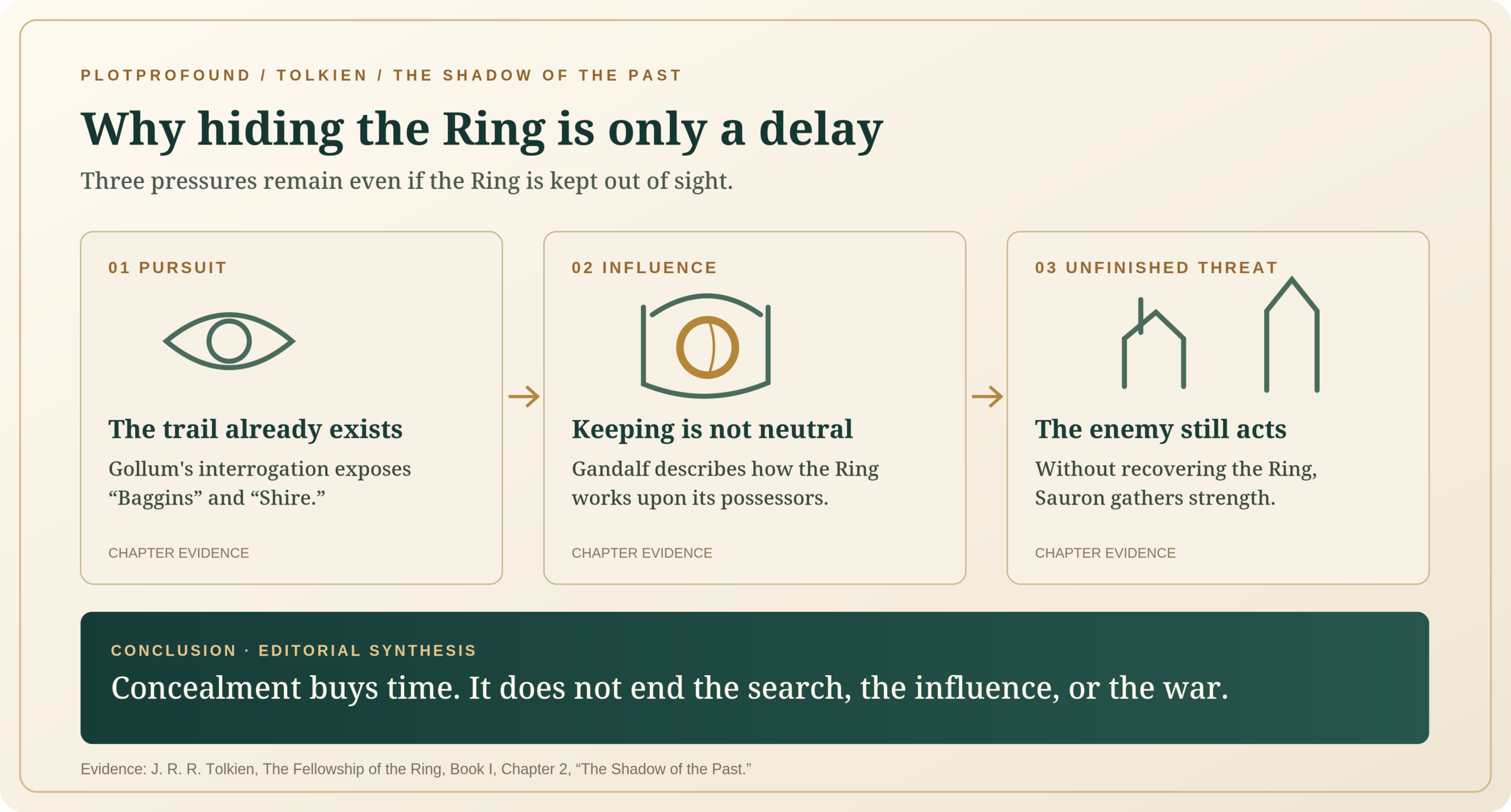
The Ring cannot be hidden forever because secrecy does not stop Sauron’s search, undo the Ring’s influence on whoever keeps it, or halt the Dark Lord’s growing power. In “The Shadow of the Past,” Gandalf explains that Gollum has given Sauron two dangerous clues: “Baggins” and “Shire.” The danger is not simply where the Ring sits. It is what pursues it, and what possession does over time.
The overlooked distinction: hidden from sight does not mean free from pursuit, influence or power.
Gandalf is not discussing a misplaced trinket. He is explaining why even a peaceful home cannot be a permanent answer.

01. A trail already exists
For years, Bilbo’s ring seems safely tucked away in the Shire. That period of obscurity matters, but it is not proof of permanent safety. Gandalf has traced Gollum’s history and fears what Gollum disclosed while held in Mordor. A name and a place have entered the enemy’s knowledge. Frodo’s home is no longer a secret beyond all discovery.
The chapter also warns that Sauron has servants, spies and many ways of gathering news. This is a search built from witnesses and pursuit, not an infallible magical locator. Hiding the Ring might delay a visitor. It cannot erase the trail leading toward its keeper.


THE QUIET DANGER
02. Possession has a cost
A locked chest would still leave someone responsible for the key. Gandalf describes how the Ring extends its bearers’ lives and draws them toward possessiveness and eventual ruin. Bilbo’s difficulty surrendering it is already disturbing evidence. The object can remain motionless while its hold on a person grows.
The plain gold band is especially deceptive. Gandalf’s test by fire reveals its identity, but an unmarked appearance had helped it pass as something much smaller than it was. Concealment protects the appearance of safety; it does not change the Ring’s nature.
It offers no guarantee that the Ring can be detected wherever it is hidden. The problem is that hiding it cannot neutralize the known risks.
THE COUNTER-READING
03. Why not simply bury it?
One might reasonably ask whether an unknown keeper could hide it in some unreachable place. The chapter does not prove that every conceivable hiding place would be discovered. Its argument is more practical and more troubling: an already compromised location, a dangerous burden on its guardian, and a powerful enemy gaining strength are not a stable plan.
Nor does Sauron need to hold the Ring to threaten others. Gandalf warns that his return to power is advancing even without its recovery. Keeping the Ring from him is essential, yet permanent concealment alone would leave that wider danger unresolved.

04. A hiding place is not an ending
This is why Frodo must leave the Shire. In this chapter, Gandalf first proposes removal, not a complete itinerary for the later quest. The decisive insight is already present: saving a hiding place and solving the Ring’s danger are different tasks. The question is no longer merely where to put it, but what future any keeper can safely promise.
A question to take back to the text
If an object can corrupt its guardian even while hidden, is secrecy ever a lasting form of protection?
Source & interpretation notes
Primary text: J. R. R. Tolkien, The Fellowship of the Ring, Book I, Chapter 2, “The Shadow of the Past.” The account of Gollum, the fire test, Gandalf’s warnings and Frodo’s departure are all anchored to this chapter.
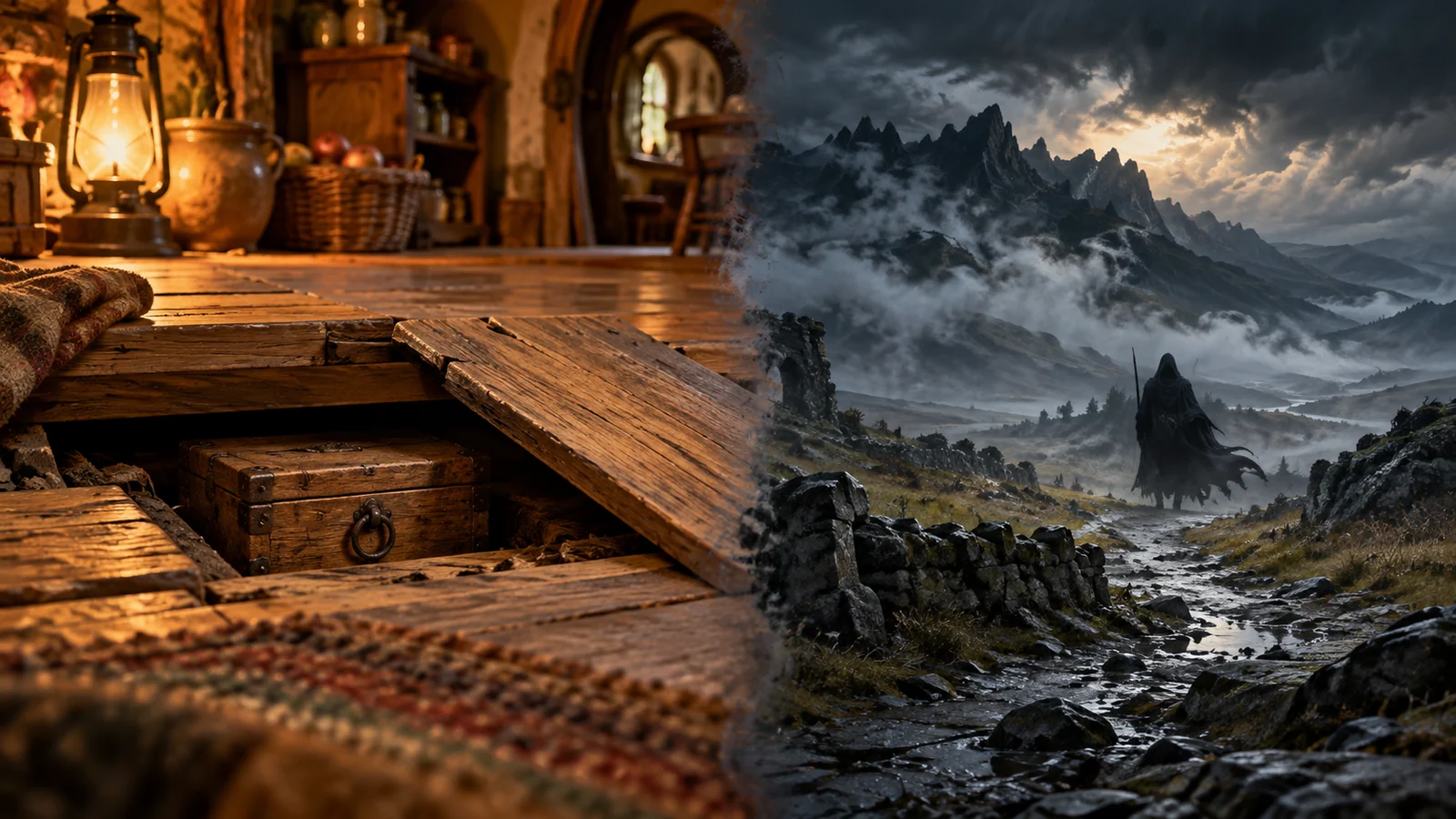
Editorial interpretation: The three-pressure framework and all visual juxtapositions are original explanatory devices. The chest, key, mountainside ring and combined scenes are symbolic compositions, not additional canonical events. No adaptation designs are asserted as evidence.
It’s so beautifully presented and all the tools this web give for reading just make the experience amazing! Thank you!